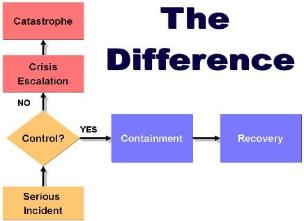
What is Business Continuity Planning?
|
|
Business Continuity Planning is a methodology used worldwide to ensure
organisations are capable of withstanding a crises which threatens the survival of
the organisation. Hence this required organisations to proactively identify threats,
risks, controls, emergency response plans, business continuity strategies and
business recovery strategies.
Broadly Business Continuity Planning can be defined as the identification and
protection of critical business processes and resources required to maintain an
acceptable level of business, protecting those resources and preparing procedures
to ensure the survival of the organization in times of business disruption.
Business Continuity Planning is process which assist an organisation not only
prepare for a potential threats but also to reduce the exposure to such threats. This
in turns improves the availability of the organisation and its processes.
To achieve this Business Continuity Planning utilize the Risk Assessment Tool as
well as the Business Impact Assessment Tool. The Risk Assessment Tool
focuses on threats to which the organisation is exposed to where as the Business
Impact Analysis Tool focuses on Processes and vulnerability of processes and the
organisations sensitivity towards the processes. As a consequence to Risk
Assessments, controls deployed to eliminate, reduce or mitigate impacts from
threats will be reviewed and augmented. On the other hand Business Impact
Assessment will lead to identification of vulnerabilities of processes and as a result
strategies to improve the availability of processes during a crisis will be identified.
Furthermore the Business Impact Analysis will also identify the availability
requirement of each of the processes and will assist the organisation to identify
strategies to recover critical processes.
|
|